Balancing Your Life Until Calling Emerges

One of the most common conversations I have with emerging leaders is not about gifting, revelation, or ministry strategy. More often, it centers around the tension of living between what God has spoken and what they are currently experiencing. Many believers have received prophetic words concerning their future. They have encountered God, sensed His call, and had that calling confirmed by mature leaders. Deep within, they know they were created for more than what they are presently doing. Yet every day they wake up, go to work, pay bills, care for their families, and carry the responsibilities of life. This creates a very real tension. They know what God has revealed inwardly, but their outward circumstances have not yet aligned with that revelation. The question becomes, “How do I stay Kingdom-minded while living under real-world pressure?”

The reality is that most ministers begin their ministry journey while working a job. In fact, eighty percent of leaders are bi-vocational, carrying both the responsibilities of employment and the responsibilities of ministry. Even many who are considered full-time ministers often develop multiple streams of income to support their calling and provide for their families. This is not a sign of failure. Rather, it is often part of God’s developmental process. The greatest challenge is learning how to remain anchored in Christ while everything around you pulls at your attention, emotions, and energy.

One of the greatest misconceptions among emerging leaders is the assumption that calling automatically means commissioning. God often reveals destiny long before He develops the capacity necessary to carry it. Throughout Scripture we see this pattern repeatedly. David was anointed king long before he ever sat on a throne. Joseph dreamed of rulership years before he governed Egypt. Moses carried a divine calling for decades before he carried spiritual authority over a nation. God consistently reveals purpose before He reveals process. Many believers assume that once they receive a prophetic word, they should immediately step into the fullness of that assignment. However, God is often more interested in preparing the vessel than releasing the ministry.

Looking back over my own journey, there are times when I wish I had received more development before ministry responsibilities increased. People start pulling on you for answers, counsel, teaching, leadership, and guidance. Opportunities multiply, but so do responsibilities. The time available for deep study, reflection, and personal development often becomes harder to protect. God understands this reality, which is why He frequently begins forming leaders long before they are fully released. Ecclesiastes reminds us that there is a season and a time for every purpose under heaven. Every calling has a season. Every purpose has a process. Every assignment requires preparation.

The Lord uses seasons of tension to expose areas within us that still require transformation. He reveals distractions that compete for our attention. He uncovers instability that remains hidden beneath the surface. Emotional weaknesses, soul reactions, misplaced dependencies, and a lack of spiritual discipline are often brought into the light during these seasons. God does not expose these things to condemn us. He reveals them because He is committed to forming Christ within us. His goal is not simply to use us in ministry. His goal is to transform us into the image of His Son.

One of the most important lessons every leader must learn is that ministry begins with God. Our first ministry is not to people. Our first ministry is to the Lord Himself. Our second ministry is to our family. Only then does ministry to others take its proper place. Many leaders become exhausted because they reverse this order. They pour themselves into serving others while neglecting their own relationship with God. Yet everything in the Kingdom flows from relationship. Jesus continually withdrew from the crowds to spend time with the Father. If the Son of God prioritized communion with the Father, how much more should we? The health of our ministry will never exceed the health of our relationship with God.

Balance becomes an essential component of surviving and thriving during seasons of transition. We are called to live in the world while remaining connected to another reality. The responsibilities of employment pull our attention toward natural concerns. The call of God pulls our hearts toward Kingdom purposes. Family responsibilities require investment. Ministry responsibilities require investment. Life itself demands attention. The challenge is learning how to hold these realities in proper perspective. For many years, I had to settle the fact that my work provided the resources necessary for me to fulfill ministry assignments. My job paid the bills, met practical needs, and created stability. It became a tool rather than an identity. Ministry remained my primary focus, even while employment served an important purpose. This perspective helped me understand that my work was not my calling. It was simply helping to support my calling.

Pressure often reveals what truly governs our lives. Does our employment govern us, or does God govern in our employment? What controls our peace ultimately controls our lives. Many people become slaves to their jobs because they allow employment to define their identity and determine their emotional well-being. Yet employers rent our time; they do not own our purpose. Our identity must remain rooted in Christ. The Word of God, prophetic promises, dreams, and visions become anchors during seasons when external circumstances have not yet caught up with internal revelation.

Many people think transition is primarily external. They assume transition means changing jobs, moving into ministry, relocating geographically, receiving a title, or entering a new season of influence. While those things may eventually occur, true transition is first an internal work. Transition is not merely moving into ministry. Transition is becoming the ministry. It is allowing the message you carry to first transform your own life. Many believers desire new seasons without embracing new mindsets. They want greater authority without deeper maturity. They want influence without transformation. Yet God uses process to renew our thinking, establish our identity, remove mixture, expose unhealthy dependencies, and develop spiritual maturity. He is more concerned with who we are becoming than what we are doing.

One of the greatest struggles believers face is maintaining spiritual awareness while carrying natural responsibilities. Many assume they would be more spiritual if they had more time, worked fewer hours, or entered full-time ministry. However, Jesus taught that the Kingdom of God is within us. The issue is not location; it is awareness. Spiritual life is not confined to church services or ministry events. A believer can carry inward communion, spiritual sensitivity, peace, authority, and Christ-consciousness while functioning in the marketplace. The Kingdom is not something we visit occasionally. It is something we live from daily. Kingdom-minded believers learn to remain aware of God’s presence regardless of where they are or what they are doing.

Spiritual stability is impossible without discipline. Paul spoke of bringing his body into subjection and exercising self-control. Discipline is not legalism; it is training. It is the intentional process of aligning our thoughts, emotions, and actions with Christ. Practical disciplines such as daily time in the Word, focused prayer, worship, meditation, stillness before God, and guarding the mind help create consistency in our spiritual lives. What continually fills our minds eventually shapes our spiritual atmosphere. If our thoughts are dominated by fear, fear will eventually govern our emotions. If our minds are filled with offense, bitterness will take root. If Christ occupies our thoughts, His peace will begin to govern our lives.

Pressure also increases during times of spiritual growth and transition because spiritual warfare often intensifies when we move toward purpose. Many believers experience warfare but fail to recognize its objective. The enemy’s primary goal is not simply to attack us. His goal is to distract us, exhaust us, confuse us, and remove our focus. He understands that clarity produces movement. When believers become clear concerning their calling and assignment, they begin taking steps toward fulfillment. Therefore, the enemy attacks clarity. He seeks to create confusion because confusion delays progress. This is why maintaining balance and spiritual focus becomes so critical during transitional seasons.

One of the greatest weapons available to believers is peace. Scripture teaches that God keeps in perfect peace those whose minds remain fixed upon Him. Peace is not the absence of conflict. Peace is the government of God operating within the believer. Mature leaders learn that peace must become a ruling force in their lives. Many lose their peace because they continually focus on circumstances, uncertainty, pressure, fear, and emotional reactions. Yet Kingdom leaders learn to live from another reality. They learn to set their affection on things above. What we focus on eventually governs us. What we meditate upon eventually shapes our atmosphere. When our attention remains fixed upon Christ, His peace becomes the ruling influence in our lives regardless of external conditions.

Ultimately, spiritual maturity is the process of learning to live from Christ reality rather than soul reality. Soul reality is governed by feelings, frustrations, disappointments, reactions, and circumstances. Christ reality is governed by union with Him. Paul declared that it was no longer he who lived, but Christ who lived in him. This is the goal of spiritual formation. Rather than reacting emotionally to every circumstance, mature believers learn to respond from their union with Christ. Instead of being governed by fear, they walk in faith. Instead of striving, they trust. Instead of being controlled by outward circumstances, they draw strength from inward communion.

If there is one thing every emerging leader must understand, it is that pressure is not necessarily proof of failure. Many times pressure is evidence that God is enlarging your capacity. Kingdom leaders are rarely formed in comfort. They are formed through process, responsibility, faithfulness, and perseverance. God uses tension to shape character and develop maturity. If you find yourself in a season where your calling seems larger than your current circumstances, do not become discouraged. Continue pursuing intimacy with God. Continue growing. Continue preparing. Continue serving faithfully where you are. The goal is not simply surviving transition. The goal is becoming transformed through it. Do not lose your peace. Do not become distracted. Do not allow warfare to steal your focus. Remain anchored in Christ, because the greatest victory is not merely reaching the next season. The greatest victory is allowing Christ to be fully formed within you while you walk through it.
Dealing with Traumas 

I had this written before the recent Tornados that hit Kentucky. The trauma they are experiencing is beyond comprehension. The loss of life, property, dreams, heritage and a how daily life was done, is a trauma that takes time for healing to occur. In these kinds overwhelming situations you will go through all the stages of loss: grieving, anger, despair and a host of other things. It is hard for those who know the Lord and the hope and peace He can bring. I honestly don’t know how anyone can have that strong of a will to make it without Him. I wrote this blog to deal with the daily issues of life more so than the catastrophes of life. I hope some of this will be applicable to both. 

There is a lot going on in culture. There are two types of things I see prevalent in the church culture right now. First is the denial of problems, pain, disease etc. It is like if we deny, it doesn’t exist. This is coming from the belief of positive confession etc. Negative things do exist and not calling it by name does not make it go away. The faith movement has made us go to an extreme of not admitting to what we are facing. Denial does make it any less real and can mask something to never be addressed. This denial thinking is not very well accepted by the emerging generation as it is not authentic. 

The second is the over focus on the problem of trauma, depression, anxiety, and a host of other societal problems. This has led to a cultural acceptance in the church that it’s ok to not be whole. Again, an honest evaluation, but not a Godly or biblical perspective. Jesus did not just heal, but made whole to the degree the effects caused by the problem were reversed as if they never occurred. But the over emphasis on trauma can create a self-destructive path and a non-deliverance mindset. The problem is real, but its magnitude is more than the answer. The focus is on self and feelings than faith and freedom. This focus on the problem more than the solution is not very well accepted by an older generation who will say “just get over it.” Which is coming from the first mindset of denying it. This position is not accepted by an older generation who has endured much. 

So, we are sitting in two different philosophies and approaches. But both have many things in common. Both approaches do not bring wholeness to the issues. Both do not have a solid pathway to resolve. Both have faith involved to a degree, but not true authentic Biblical faith. But what is positive is both have a desire to be walking in freedom as an outcome. 

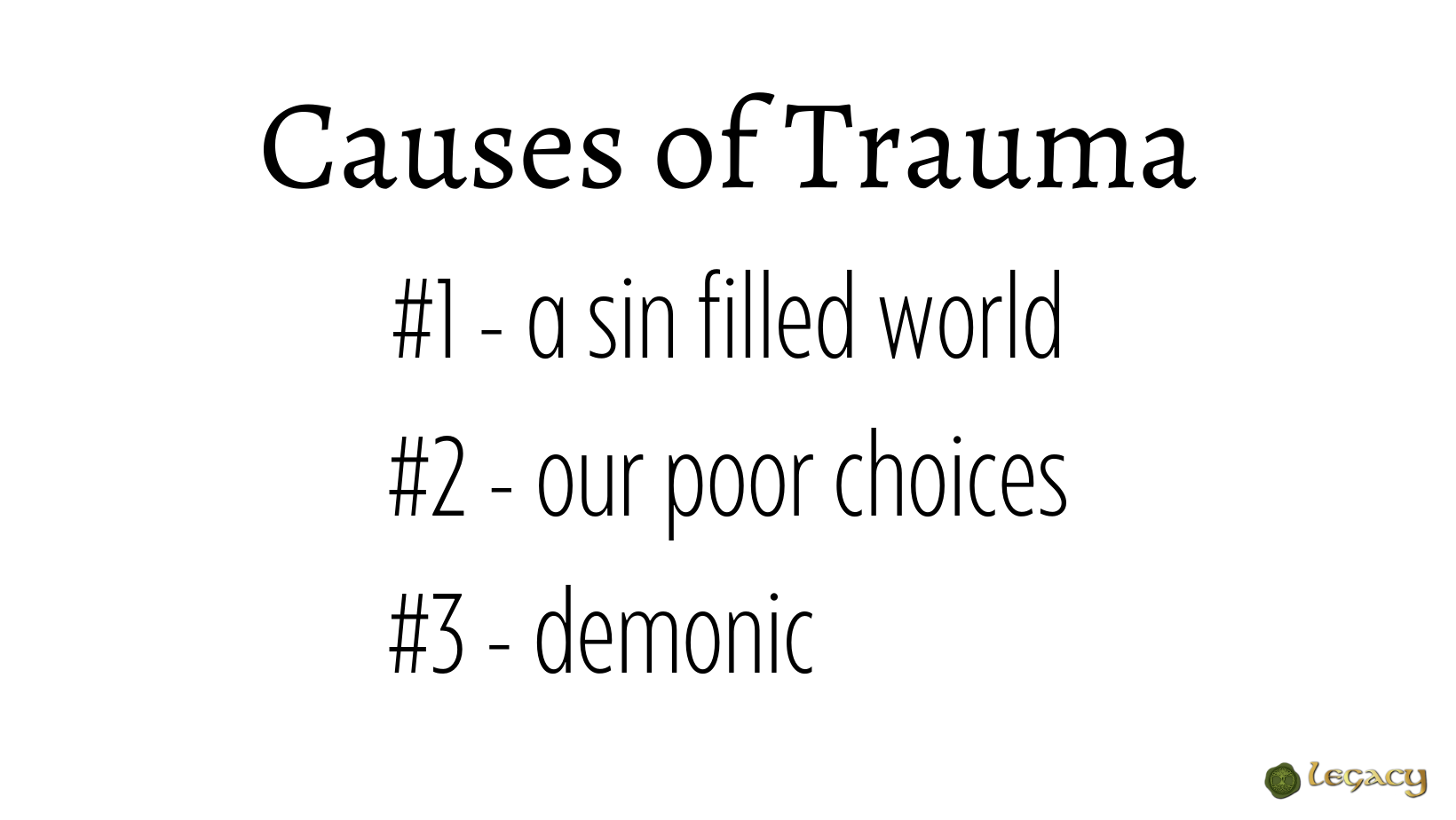
We all have things we will go through in life. I see three areas of roots causes of trauma. 

  1. First, some are just life issues due to living in a sin filled world that we feel the effects of. Unredeemed man and man’s greed and pride can come into play. These can create all kinds of abuses from others. Rape, deception in business, murder, revenge, corrupt governments, unfair situations. We can create a  lengthy list. It is the unredeemed areas of men, acted upon. These are external processes that affect a person’s life.
  1. Second, other things are our own poor decisions and responses that have caused our problems. These things create a self-induced calamity that can become a false identity and an ongoing cycle of trauma, or life events that are detrimental to our emotional and mental health. These are emotional and psychological areas that come as defense mechanisms to cope with or not cope at all. These decisions are not being responsible for our choices which have repercussions. These can create “loops” of thinking and lead us to a self-deceived state the Bible speaks of. These are internal processes. 
  1. And finally, that which seems unexplainable or makes just no sense. These things are demonic or have demonic roots. This would be the demonic attacks to slow us down, distract us and cause confusion in faith. I have experienced all of these and I’m sure you have to. But we give too much credit to demonic things and deny the first two sources. I have had my dark times in life, but I decided to not live in the darkness and allowed the light of God’s deliverance to come in. These are supernatural processes. 

At times it can become confusing as it appears all three are at work at the same time. That can be true. The demonic forces bring things to shift our faith. The same time demonic forces move upon the evil in men’s hearts to create situations that affect us. We then make decisions emotionally and intellectually more so than spiritually lead. So, what is the balance we need?

We need to not deny our problems or the problems of others, but face them from  a biblical perspective. This emerging generation needs to be taught, not denial, but how to walk out life and still find rest during the storms. We were not promised a life of ease but a life of overcoming. But to overcome there first must be a battle, or something we must gain victory over. This is where the older generation should be quick to train and encourage rather than judge or give a quick answer without investment. 

We must walk out the problems by facing them and finding solutions. For some they seek a counselor, therapist, or an emotional health person to help them deal with things. These can help, but the only way to truly be free is to allow God to deliver, heal and make whole by restoration. Lazarus was dead and Jesus called him asleep first, but because the people couldn’t go there in understanding, he finally said, “He is dead.” Jesus came to change the life calamity with light and life. His perspective was positive, not negative. Others were sick or demonized and Jesus recognized the condition, and then addressed the thing holding people bound. What is needed is a perspective from God, not ourselves. From the potential of faith which exceeds our understanding. If we don’t shift into a position of faith, then things will hold a grip on us, a grip that is more intellectual, and emotional based on the current condition and not the future. 

When I came into the kingdom many years ago, there was not any of the counseling things we have today. If you had a problem or anxiety, depression or any type of emotional problem you and God worked it out. Your dependency grew on God until you had a breakthrough. You were also dependent strongly on the spiritual community you engaged in to stand with you, hold you accountable and walk out healing with you. It made us closer and more connected in heart. No one journeyed in trauma alone. We had emotions, we had feelings, but it was our faith in God that caused breakthrough. We didn’t deny, but lived above things, knowing God was our breakthrough.

God is near those who are broken-hearted. God does not draw close to just bring comfort, but comes to resolve or bring change. Every time Jesus was near those broken hearted, he brought a shift into their lives. Jesus is the agent of change, and his involvement will always produce change. Like all healing it is God who is the ultimate healer. He has allowed healing to come by all kinds of ways. He uses doctors, people, loved ones, friends, and even kids at times. All are relationships and that is what we experienced in my early years. Someone in my  Christian circle could be carrying your answer. If you are out of fellowship, you could be delaying your answer. I have seen this happen constantly, that an answer was given in a meeting, but the person wasn’t there and never heard it, so they struggled until the answer came again later in the future. 

Some emotional traumas are how others have treated us physically and emotionally, abusing us. Those require healing, time and seeing God step in to make us whole again. Many other emotional traumas we face come because of what we hear or assumptions we make. We are quick to allow our mind to imagine all kinds of fantasy. I had a spiritual daughter come to my office and demand I tell her who was talking about her behind her back. I told her, “No one.” After about 20 minutes of arguing she would not back down. I told her, “O.K. I’ll tell you who is talking about you, there is only one person and it’s you!” Sometimes we make things bigger than they are. We also hear in ways that come from past hurts so what we hear may not be completely accurate. It really comes down to not what we hear but how we hear. A person may be accusing but it may be coming from their own insecurity or hurts. It’s how we hear their voice in the accusation. Do we hear the accusation or the hurt it comes from? 

Jesus said in the parables to be careful “How” we hear. The problem is not hearing God’s voice but distinguishing it with confidence  from all other voices. There are five voices affecting our spiritual ears.

  1. God’s voice – which can be a still small voice
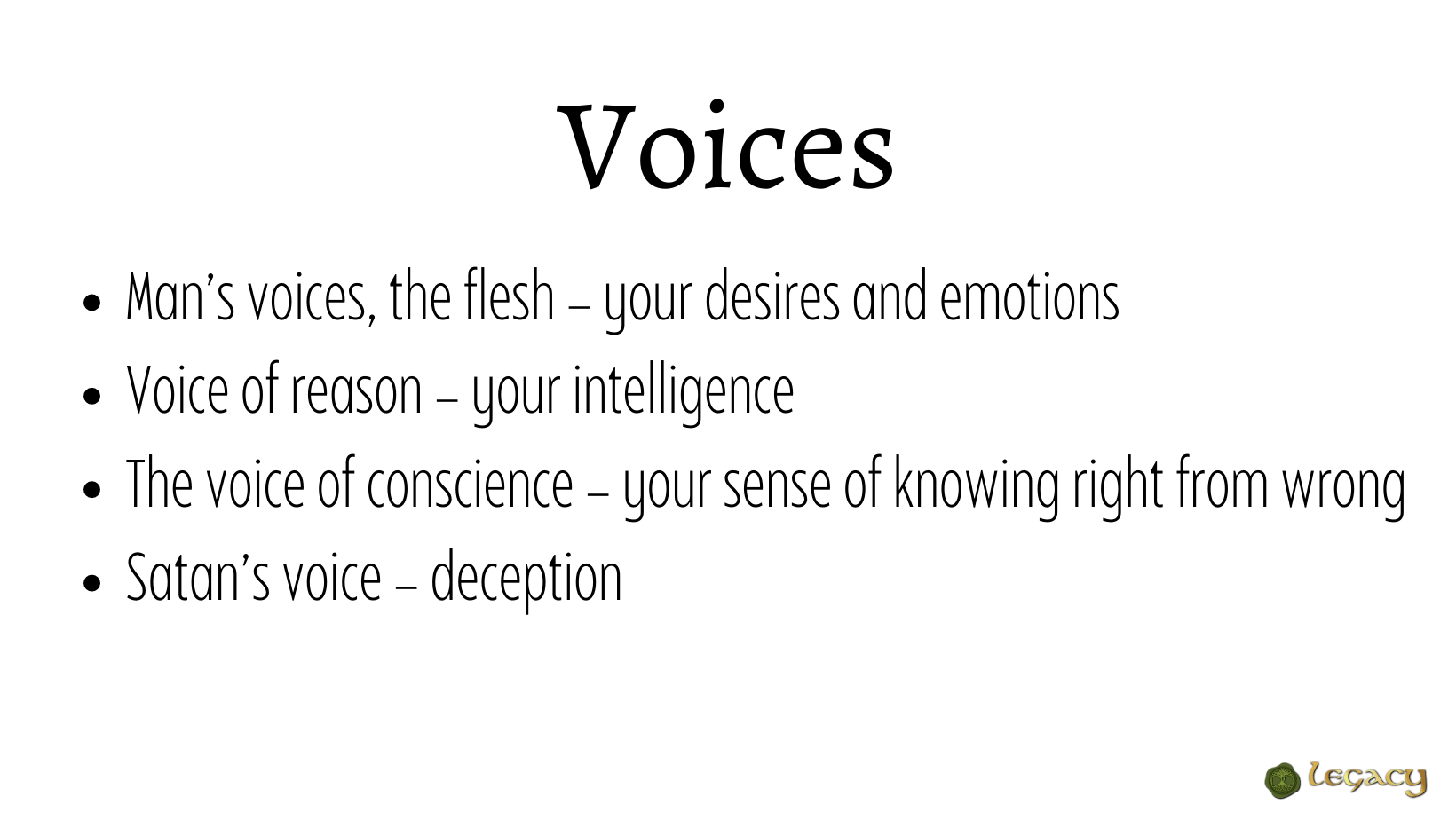
  2. Man’s voices, the flesh – your desires and emotions
  3. Voice of reason – your intelligence
  4. The voice of conscience – your sense of knowing right from wrong
  5. Satan’s voice – deception 

All of these have certain familiarities to them. We are most familiar with our intellect and our conscious. Then our voice or emotions, then satan’s, and finally God’s. As you see God’s voice is at the end and the other voices are entertained. If we create a new order of God’s voice first the outcome becomes; our conscience will submit to it, our intellect will embrace it, our desires and emotions will yield to it, and Satan’s voice will be diminished or gone. 

As I said, we all go through traumatic events in life due to one of the three reasons. We are not going to avoid it. It’s how we negotiate the moment and what voices we are allowing to dictate and form us during it and afterward. You can tell by this story how I negotiated the three areas and the five voices. 

I can remember being clinically depressed for over a year. I was transitioning into the apostolic from the prophetic and I had not heard God’s voice for a year. I also was denied any ministry role everywhere I turned, and leaders were pitting people against me. I was hearing all the voices, but the most important, God’s. I was trying to sort out what decisions I had made that were wrong (there weren’t any). And I was living in others unredeemed responses and oversight in my life. I knew the enemy was trying to stop me at every turn and constantly spoke to me about failure, unqualified, rejected, no value and would never find my purpose, identity or do anything of any value for God. I fought all the voices, all the influences, and still wasn’t having break-through. During it, my youngest son died and was pronounced dead in the hospital. I got the call and instead of conscious or emotions or intellect or even the voice of Satan dictating, I allowed God’s voice already in my spirit to rise. Remember, I was in a deep depression and hadn’t heard God’s voice for a year. But His voice was still in me, just buried in the mud of everything. I told the devil he could take everything, but wouldn’t take my son. Not a tear, not a fear, not a voice of reason, but the gift of faith came to me. I went to the hospital and raised him off the table 2 hours after he had died. You see, denying the other voices has given my son from that day (Dec 2) 30 more years of life so far. Which could have been for me, to live in 30 years of trauma instead. It came down to a decision I had to make concerning God’s role in my life. 

I know this short teaching doesn’t cover every unique detail, but I will say I have helped people work through all kinds of abuse, trauma, suffering, rejection, mental stresses, emotional upheaval etc. all thinking in the moment there is no way I’ll ever get free. Yet they all did. Some in a few weeks and others many years. You can avoid future things by hearing God, and you can heal from past things by God speaking into you. Everyone is only a guide to healing, be it emotional, mental, or physical. But the bottom line is, God is the one who brings the wholeness. All those things do not define who you are to God and what you can do for Him upon the earth. There are many things to bring wholeness, but dealing with the voices is a main hurdle to overcome and will help in the entire process. I hope this helps you break free from a cycle you may be in, and I also hope it helps you heal from past hurts.